18 Jun Al-Qaida’s post-9/11 demise not driven by effective counterterrorism, research finds
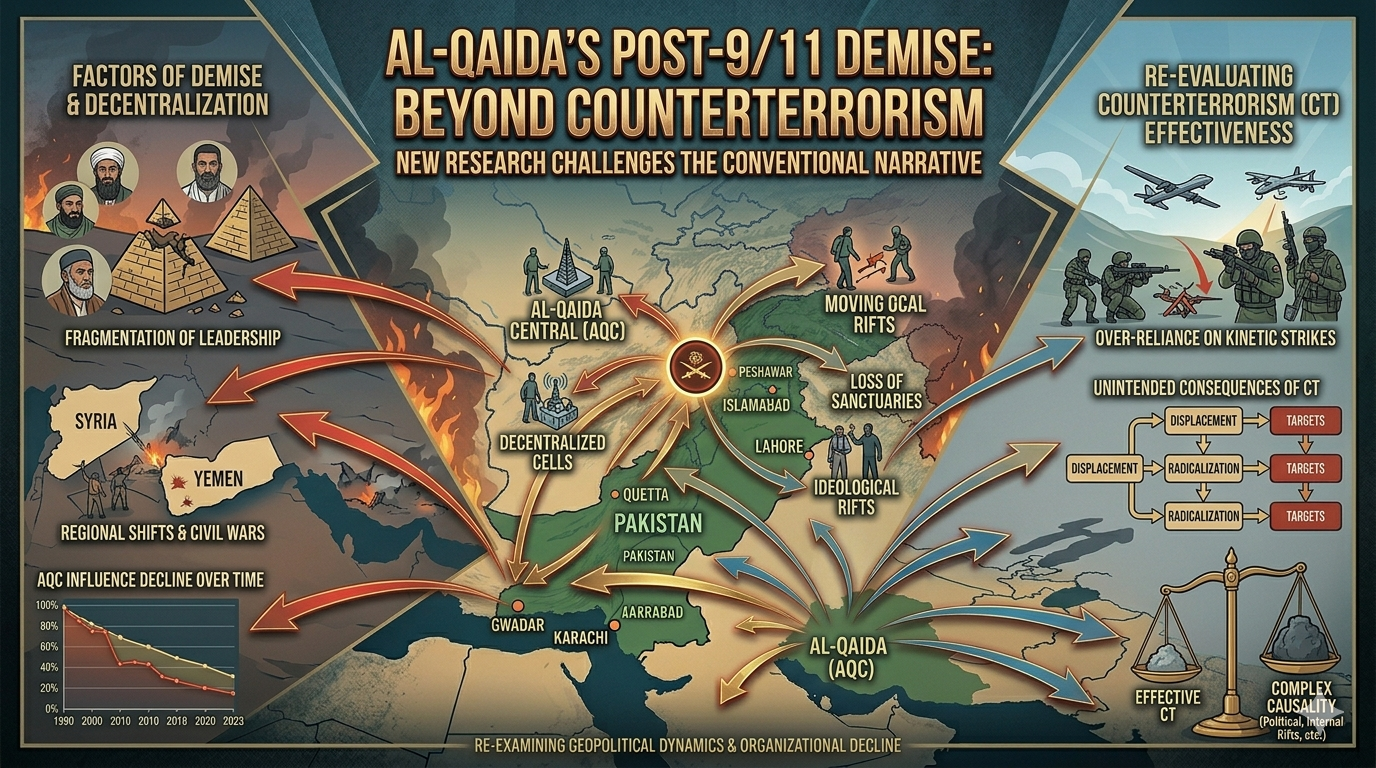
Islamabad–Al-Qaida’s demise after 9/11 was not simply the result of effective counterterrorism, rather it stemmed from the militant group’s organizational weaknesses and the shortcomings of its individual leaders played a vital role.
This is one of the key findings of the book ‘Al-Qaida after 9/11: The War on Terror and the Decade of Demise,’ which was launched here at an event hosted by the Islamabad-based Pak Institute for Peace Studies (PIPS).
Dr Anne Likuski, Senior Researcher at the Norwegian Defence Research Establishment, has authored the book. She specializes in Al-Qaida’s history, leadership and strategy and jihadism in Afghanistan and Pakistan.
A focus group discussion followed the launch ceremony that provided an opportunity for scholars, policymakers, experts, researchers and media professionals to engage in an informed talk on the evolution and the status of Al-Qaida, the broader terrorism landscape in the region and beyond, and their implications for contemporary security and counterterrorism discourses.
The gathering featured the author, Dr Likuski, who shared insights from her research and engaged directly with attendees.
The research explores how the ‘War on Terror’ impacted Al-Qaida in the decade after 9/11. The book is the first to analyze the inner workings of the group through the eyes of its mid-level leadership in Pakistan. It relies on a large collection of the “Abbottabad documents”–the group’s own, internal communications between 2002-2011. The documents were found in the house of Al-Qaida leader Osama bin Laden when he was killed in a US military operation in 2011 and were later released by the CIA in November 2017.
The book explains why Al-Qaida’s contributions to the Afghan war were “modest,” shows the reasons for the group’s inability to influence events in Iraq, and charts its “fading ability” to organize international terrorist attacks.
Speaking at the ceremony, Dr Likuski said that her motivation for writing the book was lack of a detailed history of Al-Qaida after 2001. “Al-Qaida changed fundamentally–from being a group dedicated to fighting to a group dedicated to governance,” she said while explaining how the War on Terror affected the organization. This reflected the fact that Al-Qaida was always an “ambiguous” organization without having “a static and clearly defined ideology and goals,” she added.
Dr Likuski noted that she had assessed Al-Qaida’s performance in three areas: the war in Afghanistan; the war in Iraq; and international terrorism.
Professor Arshi Saleem Hashmi of the National Defence University (NDU) said Al-Qaida was a phenomenon that had been continuously evolving.
Center for Research and Security Studies (CRSS) Executive Director Imtiaz Gul said this needed to be probed whether all militant organizations operating in Afghanistan were organic entities or they worked as proxies for others.
Dr Ishtiaq Ahmad, Professor Emeritus at the Quaid-i-Azam University (QAU), said the writer had dealt with a very complex subject. He questioned whether there was some rationale behind the past rhetoric that Taliban was a global jihadi organization.
Thomas Smikop Dahl, Deputy Head of Mission at the Norwegian Embassy in Islamabad, said it was very important for them on the policy side to go to the primary sources to know how people tend towards extremism and terrorism. He thanked all the participants for attending the session.
Former National Counter Terrorism Authority (NACTA) national coordinator Ihsan Ghani, while presiding over the session, said the research acted as a mirror for the international community, noting that the author had done a great service for researchers and academia. “The research explains how Al-Qaida collapsed under its own weight because the leadership was cut off from ground realities, the group did not trust anyone and there was a mistrust among them as well,” he said.
“The book is a very well-resourced and important document for us to understand dynamics of Al-Qaida and how they are linked with the present situation,” said PIPS President Muhammad Amir Rana.