01 Jul PIPS hosts discussion on “Emerging Terrorism Landscape: Policy Options and Challenges”
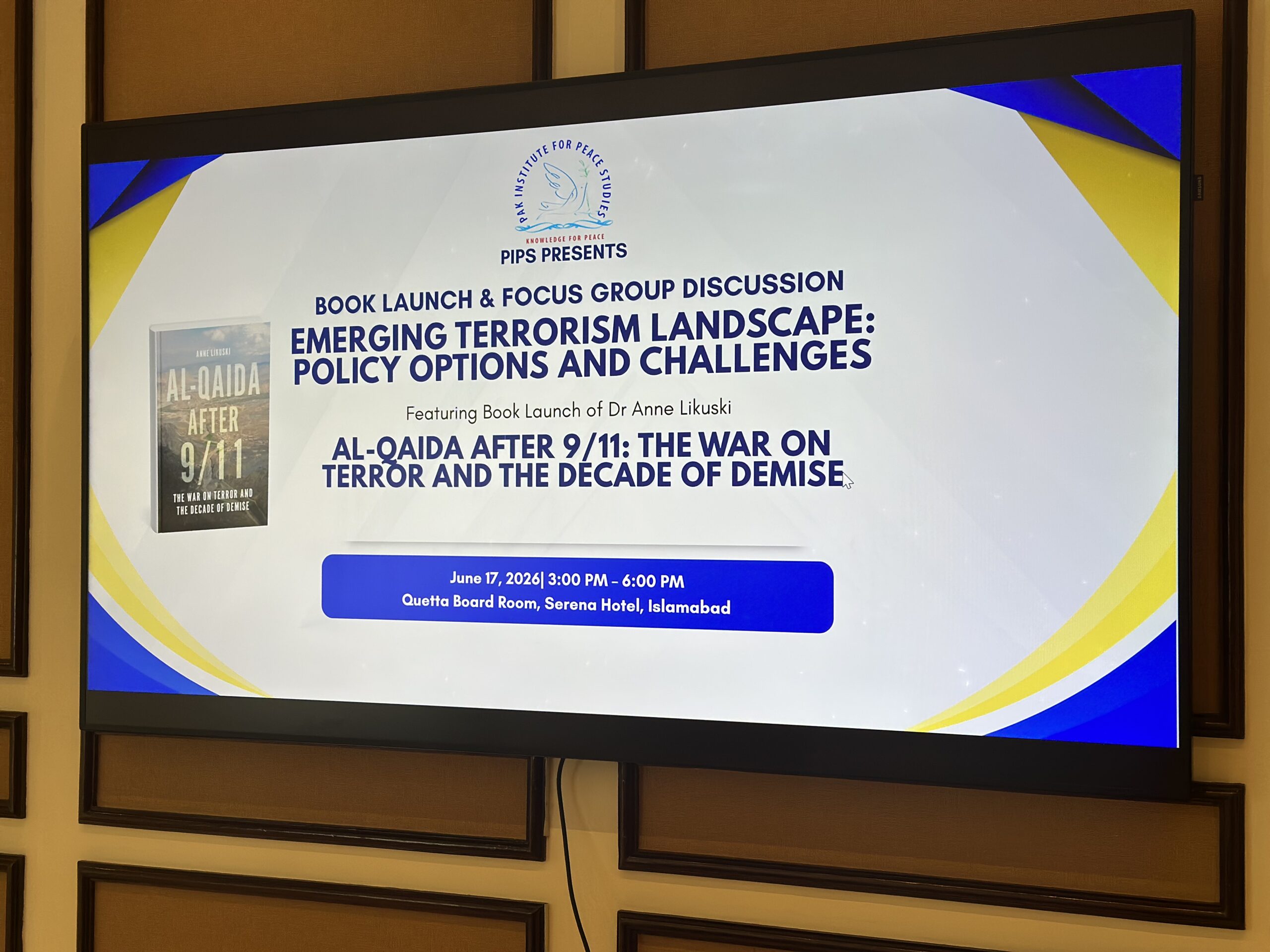
Pak Institute for Peace Studies (PIPS) organized a book launch event, followed by a focus group discussion “Emerging Terrorism Landscape: Policy Options and Challenges,” at Serena Hotel, Islamabad, on June 17, 2026.
The book’s title is “Al-Qaida after 9/11: The War on Terror and the Decade of Demise,” which is authored by Dr. Anne Likuski, who is Senior Researcher at the Norwegian Defence Research Establishment (FFI), Norway. She specializes in Al-Qaida’s history, leadership and strategy and jihadism in Afghanistan and Pakistan. She is also the author of Al-Qaida in Afghanistan (2017).
Ihsan Ghani, former national coordinator of the National Counter Terrorism Authority (NACTA), chaired the event and PIPS President Muhammad Amir Rana moderated it.
The session started with Rana’s introductory remarks. This was followed by Dr Likuski’s speech who explained the relevance of the book for Pakistan and Afghanistan. Then she defined what she meant by Al-Qaida. She explained that she was motivated to write the book because she had access to collection of documents linked to the militant group. She defined Al-Qaida as a historical organization started in Peshawar, then it was based in Sudan. “The book covers Al-Qaida’s history because after 2001, there was a dearth of academic study on Al-Qaida.”
The writer explained that the research question focused how Al-Qaida was affected by the ‘War on Terror’ in the decade after 9/11. The short answer for this is that, she said, Al-Qaida changed fundamentally from being a group dedicated to fighting to a group dedicated to governance. “It also reflects the fact that Al-Qaida was always an ambiguous organization; it did not have a static and clearly defined ideology and goals.”
Dr Likuski mentioned that before 2017, it was challenging to write a detailed history of Al-Qaida due to lack of primary sources. In November 2017, the CIA released the “Abbottabad documents” that include former Al-Qaida chief Osama bin Laden’s personal correspondence. She mentioned that Al-Qaida leaders lived in separate locations, so discussions about the group’s work and strategy were conducted via letters and Bin Laden’s political decisions were often shaped by his subordinates. During the session, she explained in detail the outline of the book.
After this presentation, Rana thanked the author and called the book well-researched. Senior journalist and The New York Times Contributing Reporter Zia ur Rehman expressed his opinion on Al-Qaida. After that, Independent Urdu Managing Editor, Haroon Rasheed, mentioned that this was an important topic. He explained that it was good to know the roots of this organization.
Aarish U. Khan, Head of Afghanistan Program at the Institute of Regional Studies (IRS), analysed the relation between Al-Qaida and local militant groups. Professor Arshi Saleem Hashmi, Dean of the Faculty of Contemporary Studies, National Defence University (NDU), engaged with the author and presented her opinion. She said Al-Qaida was a phenomenon that had been continuously evolving.
Center for Research and Security Studies (CRSS) Executive Director Imtiaz Gul questioned whether all militant organizations operating in Afghanistan were organic entities or they worked as proxies for others?
Dr Ishtiaq Ahmad, Professor Emeritus at the Quaid-i-Azam University (QAU), took the discussion further, praised the book and highlighted how the research successfully touches on the narratives despite a dearth of primary sources. He said the writer had dealt with a very complex subject. He questioned whether there was some rationale behind the past rhetoric that Taliban was a global jihadi organization?
Thomas Smikop Dahl, Deputy Head of Mission at the Norwegian Embassy in Islamabad, said it was very important for them on the policy side to go to the primary sources to know how people tend towards extremism and terrorism. He thanked all the participants for attending the session.
Former National Counter Terrorism Authority (NACTA) national coordinator Ihsan Ghani, while presiding over the session, said the research acted as a mirror for the international community, noting that the author had done a great service for researchers and academia. “The research explains how Al-Qaida collapsed under its own weight because the leadership was cut off from ground realities, the group did not trust anyone and there was a mistrust among them as well,” he said. At the end, the Chair, Ihsan Ghani, mentioned key notes. He thanked the author and the audience before wrapping up the session.