
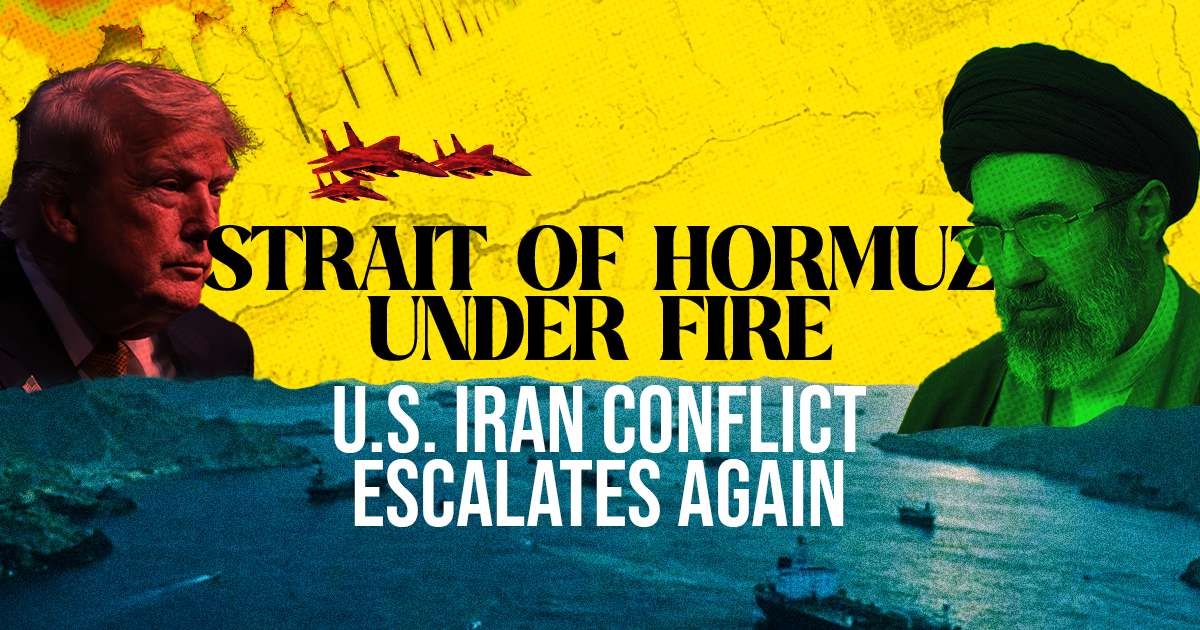
21 Jul Strait of Hormuz Under Fire: U.S. Iran Conflict Escalates Again
The Strait of Hormuz is the most important choke-point in the global energy security system. Spread across twenty-one miles this pathway hosts approximately one-fifth of the world’s seaborne crude oil and global liquefied natural gas exports. Therefore, any disruption has almost an immediate impact on freight rates, insurance markets and downstream fuel prices around the world. Hence, a bilateral ceasefire negotiation between the United States and Iran is a systemic risk event with a high risk of failure.
The interim arrangement was ratified as the Islamabad Memorandum of Understanding on June 17, 2026. The agreement facilitated the reopening of the Strait of Hormuz under preferential arrangements. It also launched a process of phased lifting of sanctions deferred contentious issues relating to the nuclear agreement and the addressed questions concerning the legal jurisdiction of the Strait of Hormuz. But the truce was short-lived. In the last week of June, a series of drone and projectile attacks were carried out on commercial tankers operating under Singaporean, Panamanian, Qatari, Saudi and Liberian flags. These attacks which were blamed on Iranian forces lead to retaliatory attacks on Iran’s southern coast. Within a week, the escalation extended to direct attacks on Bandar Abbas, Bushehr and, eventually, Tehran. Iran retaliated with attacks on U.S. bases in Bahrain and Kuwait. Furthermore, President Trump’s statement that the “cease fire is over”, made on the sidelines of the NATO meeting in Ankara changed the course of the process which had been managed through the persistent efforts of the mediators, leading instead to an open-ended coercive signalling between the U.S. and Iran.
This article argues that the Islamabad framework was violated along three fault lines. First the agreement contained ambiguous provisions regarding the jurisdiction of the Strait of Hormuz. Second, the presidential remarks made through official diplomatic channels undermined the spirit of the agreement. Third, rather than responding through direct military confrontation, Iran adopted an asymmetric strategy that altered the dynamics of the crisis. Together, these developments reflect a broader transformation of the Gulf’s security, where negotiated and mediated de-escalation is increasingly giving way to instability and the erosion of military deterrence.
The operational parameters of the escalation in July were a deliberately and carefully calibrated by the U.S. The initial CENTCOM response to the June 26-27 strikes on the tanker Kiku was relatively limited, with around 10 Iranian military targets being struck. These included drone storage facilities, air-defence radars, and minelaying infrastructure. The USA’s reaction to the attack on the three ships at the start of July was much more serious, with CENTCOM claiming to have targeted more than ninety military targets along the southern coast of Iran, including air-defence batteries, drone and missile launch sites and logistics nodes. All of these attacks were carried out in the area adjacent to Bandar Abbas, Chabahar, Jask, Bushehr and the disputed Abu Musa Island. In fact, this shift from a “punitive” to a “degradation” campaign was indicative of the fact that Washington had abandoned any idea that limited, reciprocal restraint could take the place of joint control of the waterway and that it would impose military costs to force Iran to comply.
What Tehran would more likely have been doing was adopting asymmetric leverage strategy consistent with IRGC doctrine and less constrained by its lower conventional force capabilities as a result of the war in February. Instead, Iranian troops targeted the United States’ basing and logistics infrastructure in the host nations of Kuwait and Bahrain, such as Camp Arifjan and Ali Al Salem, the Juffair and Sheikh Isa complexes. Besides the kinetic effects, most of these attacks were intercepted by U.S. and allied air-defence systems. There was also a coercive-signalling effect whereby Iran demonstrated it still had the capacity to cause damage to the network of U.S. bases without having to engage U.S. naval forces in the strait itself. Thus Iran managed to preserve a degree of plausible deniability in formal escalation against the U.S. itself.
This bifurcated retaliatory architecture shows an underappreciated vulnerability in the security architecture of the Gulf: that of the host countries that did not instigate nor have control over the escalatory trajectory of the conflict. Kuwait and Bahrain particularly occupy a precarious position within the broader architecture of Gulf security, owning to their longstanding bilateral defence cooperation agreements with the United States, under which both states host American military installations and personnel. This agreement, while central to their respective security postures, has effectively positioned them as the primary bearers of the kinetic risk in the event of bilateral confrontation between Iran and United States. This disproportionate exposure has placed a strain on the domestic political sustainability of territorial hosting agreements. Therefore, this risk has reinvigorated a longstanding debate within Gulf Cooperation Council member states regarding the strategic costs associated with facilitating US power projection from their territory.
The demise of the framework in Islamabad must be viewed in the light of the personalised, transactional, approach of President Trump towards Iran policy since the signing of the memorandum. He did not announce the ceasefire “informally” with NATO Secretary-General Mark Rutte, but rather by the president’s “real-time assessment” of Iranian behaviour. Unfortunately, it has been a hallmark of the fate of a multilateral-adjacent framework agreement to be bound to the president’s “real-time assessment” of Iranian behaviour and not by the mechanism for dispute resolution set forth in the memorandum. The effectiveness of the MoU is contingent upon the discretionary disposition of the president, his capacity to unilaterally rescind Iran’s conditional oil sales licence. This was one of the principal economic incentives embedded within the MoU, and the behaviour of the U.S. president undermined the agreement’s stability and exposed it to abrupt policy reversal.
The institutional opposition in the U.S. is also not supportive of the unreliable behaviour of President Donald Trump. Even as strikes escalated, there was a dual track signalling problem to Tehran, with escalatory and conciliatory signals, being communicated simultaneously as there were still some back-channel negotiations between administration officials and Iranian officials. Legislatively, the war has left a very durable bipartisan condemnation: both the House and Senate have passed War Powers Resolution bills which would have compelled the president to withdraw from the war without the consent of Congress, and some Senate Republicans joined the Democrats to pass the non-binding measure. Progressive lawmakers like Rep. Delia Ramirez and Sen. Elizabeth Warren have been more vocal about the war-powers mechanism as a means for curbing further escalation and the president’s authority to go to war without an authorization for use of military force. The non-binding nature of the resolutions is a reminder of one of the problems with enforcing US war powers: the executive can continue to fight a kinetic war even if it is expressly disapproved by both sides of the aisle in Congress.
In the meantime, Iran’s attitude has become more hardline regarding the explicitly jurisdictional reading of the MoU’s provisions on the Strait of Hormuz. The foreign minister Abbas Araghchi had earlier on several occasions stated that the waterway was not international waters, rather Iranian and Omani, and that the memorandum’s pledge of toll-free passage was for a limited period of time and in the absence of any hostile action. Iran’s Supreme National Security Council has issued declarations that support this description, claiming that the presence of U.S. and allied military vessels in the strait is destabilizing in itself, and that Iran has the right to determine what vessels are non-hostile. This is not merely rhetorical jurisdictional argument; rather it represents a new interpretation of the strait: as an expanded control zone, not only the narrow geographic chokepoint, that is an integral part of the IRGC Navy’s operational doctrine, and is incompatible with the American understanding of the strait as an unrestricted international waterway. Therefore, this deadlock in negotiations should not be seen as merely a conflict of mistrust, but as a genuine conflict of interpretation over central operative clause of the memorandum in question.
The macroeconomic transmission channels of a long-lasting Hormuz disruption are well known and should be recalled in view of the fragility of the memorandum. When the war-risk insurance premiums on ships using the strait are jacked up ten times or more, when charterers detour around the Cape of Good Hope, or cancel bookings, and thus reduce the available tanker capacity, and freight rates, worldwide, not just in the strait; when action continues in or near the strait for days before or after an attack. However, the fragility of the memorandum was already evident even during the de facto implementation of the ceasefire: daily vessel transits remained significantly below pre-war levels and shippers began pricing in the possibility of another closure long before the formal collapse of the truce. Oil prices also responded noticeably to each attack on the commercial tankers, demonstrating that uncertainty surrounding the disputed jurisdictional provisions of the fourteen-point memorandum continued to generate market volatility.
The key question is now whether diplomacy can take a turn for meaningful comeback. Pakistan’s mediation alongside Qatar’s diplomatic efforts in offered a meaningful framework for dialogue and de escalation in the regio. However, the recent collapse of ceasefire has cast doubt on the prospects for future crisis prevention and has raised serious concerns about the erosion of crisis stability in the region. The region has entered an era where military pressure outweighs diplomatic efforts as the primary means of resolving disputes.
If this recurring trend military of strikes continues, the Gulf may increasingly witness military confrontations over the strategic waterways rather than their periodic management through diplomatic agreements. This shift will have serious repercussions for impact energy markets and is likely to encourage Gulf states to further militarise their security policies. Resultantly, the region may become increasingly embroiled in persistent cycle of instability.
Reference
This article draws upon the PIPS Talks podcast titled “Strait of Hormuz Under Fire: U.S. Iran Conflict Escalates Again.”