12 Jun China’s Strategy for Retaining Pakistan within Its Sphere of Influence
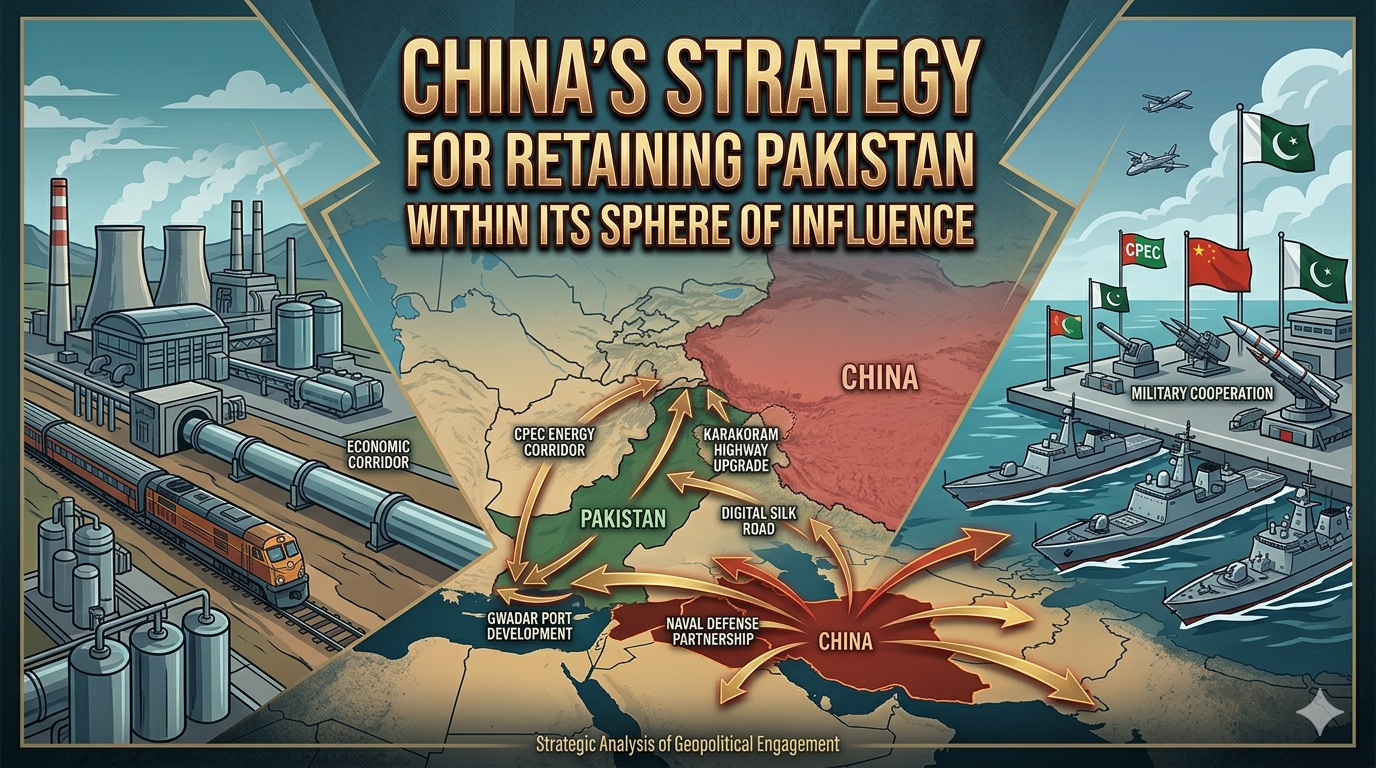
Geopolitically, Pakistan and China have traditionally referred to their relationship as that of “iron brothers” or “all-weather friends.” Pakistan was one of the first few nations to acknowledge the People’s Republic of China in 1950. The two countries later quickly concluded agreements for mutual defence. China has supported Pakistan in terms of military and diplomatic support for many years. In September 1986, for instance, during the late Cold War period, it signed a nuclear cooperation agreement and acted as a counterweight to India. China has long been Pakistan’s strategic ally in the face of regional adversaries. President Xi Jinping’s Belt and Road Initiative (BRI) has further consolidated this strategic collaboration in recent years. The CPEC, which was introduced in 2013 and was hailed by Islamabad as a game-changer for growth, is China’s flagship project in Pakistan. Under the umbrella of CPEC China and Pakistan have signed numerous agreements on transportation, energy, and infrastructure. For instance, the Karakoram Highway, a significant part of CPEC, was extenisvely renovated.
Political alignment has been closely linked to economic cooperation between the two countries. President Xi Jinping and Pakistani Prime Minister Shehbaz Sharif reiterated a renewed and expanded consensus to reinforce the All-Weather Strategic Cooperative Partnership in a joint statement during the May 2026 summit in Beijing. At that meeting, Pakistan notably and openly reaffirmed its support for China’s fundamental foreign policy stances. Pakistan agreed to be a part of China’s proposed five-point Middle East peace plan and emphasized the “One China” principle, which rejects Taiwan’s independence. In response to China’s worries about organizations like the Pakistani Taliban and the East Turkestan Islamic Movement (ETIM), both sides further promised to oppose any exploitation of territory (such as Pakistan or Afghanistan) by extremists against China. In summary, official remarks highlighted mutual support in international affairs and shared worldviews, signifying the strategic confidence China has in Islamabad.
According to independent investigations China has become deeply entrenched in Pakistan’s economy. The current total of Chinese pledges under CPEC and related BRI activities is between $62 and $65 billion. Energy projects like coal, wind, solar, and nuclear power plants, as well as highways and railroads, special economic zones, and the expansion of Gwadar port, have all benefited from this money. Different reports suggest that PRC has established itself as a strategic partner for Pakistan with an investment package surpassing $65 billion, allocating significant resources to vital areas including energy, law enforcement, transportation infrastructure, and Gwadar Port. Furthermore, Gwadar is the cornerstone of the China-Pakistan Economic Corridor (CPEC) and is located on Pakistan’s southwestern coast and provides China with sea access across the Strait of Malacca. It also plays a significant role in the regional and global politics because of its geographical proximity with Strait of Hormuz. The port also strategically connects South, Central, and Middle Asia and offers China an alternate trade route.
Pakistan’s balance sheet reflects China’s financial influence. China is by far Pakistan’s biggest creditor, with a foreign debt of about $100 billion. About 30% of that debt is owing to China or Chinese institutions, according to U.S. and Pakistani authorities. For instance, according to Reuters, U.S. officials referenced the IMF’s conclusion that “China and Chinese commercial banks held about 30% of Pakistan’s total external debt of about $100 billion.” China is now the “largest single bilateral creditor” of Islamabad. A large portion of these loans support CPEC initiatives. The leaders of Pakistan have made several attempts to restructure CPEC financing. For example, in mid-2024, the government of Pakistan requested that Chinese energy companies and authorities postpone paying back an approximately $15 billion to $17 billion debt in the power sector and convert their dollar-denominated terms into renminbi. These demands reportedly remained unanswered. These incidents highlight how financial reliance can result in leverage and the necessity for Pakistan to strike a balance between its pressing need for investment and its mounting debt.
Chinese advantage is also evident in the conditions of infrastructure agreements. According to a 2017 report to Pakistan’s Senate, China will get 91% of Gwadar Port’s earnings under a 40-year build-operate-transfer agreement, leaving just 9% for Pakistan, a distribution that raised concerns among lawmakers about its highly unequal nature. The majority of CPEC contracts have been given directly to Chinese companies, in contrast to Western-style public tenders, which has fuelled concerns about transparency. The populace of Balochistan is still impoverished despite the billions in promised projects, according to experts, who also point out that local communities have seen limited tangible economic benefits.
Chinese strategy in Pakistan goes beyond economics to include broader regional planning and military-security cooperation. China has been given broad access to Pakistan’s territory. Analysts point out that the Gwadar port project, for instance, “represents the PRC’s larger geopolitical goals in the Indian Ocean,” despite its nominal civilian status. China may be able to spread aviation and naval power far from its boundaries if port and transportation developments are completed. In fact, foreign observers have conjectured that China would look to establish a naval base in Gwadar to safeguard its interests in the Arabian Sea; the United States and India would be alarmed by such a move. The sheer number of Chinese security and military personnel in Pakistan has increased, regardless of whether a facility is constructed. Pakistan’s armed forces and paramilitaries now frequently train alongside their Chinese counterparts, and China has provided Islamabad with advanced equipment such as nuclear reactors, frigates, and drones.
China would only finance projects if Pakistan ensures their safety. Security is a two-way street. Pakistan made a public commitment in May 2026 to take “targeted measures” to protect Chinese investments and labour. This was no meaningless promise, as extremists have frequently targeted Chinese interests in Pakistan. For example, in March 2024, eight militants were killed as Pakistani authorities resisted gunmen from the Balochistan Liberation Army (BLA) who had stormed the Gwadar Port complex. According to Al Jazeera, Gwadar has been hit in several waves and is home to hundreds of Chinese labourers. For instance, an ambush on a Chinese engineering convoy in August 2023 and an attack on a hotel in 2019. Every attack targets what China has referred to as its “showpiece” projects, compelling Islamabad to increase police and military presence in unstable Balochistan. These security requirements effectively link Pakistani policy to Chinese security imperatives which include that Pakistan cannot permit organizations that China considers adversaries, such as the TTP or the East Turkestan Islamic Movement, to operate on its territory. Both countries renewed their vows at the 2026 meeting to halt such militants from using Pakistani territory. This demonstrates how Chinese geopolitical considerations affect Pakistan’s internal security posture.
Analysts emphasize that Pakistan’s foreign policy is influenced by China. In international venues, Pakistan frequently adopts Chinese rhetoric. For instance, during Sharif’s visit in May 2026, China’s leadership commended Pakistan for backing Beijing’s endeavours, including the “One China” concept regarding Taiwan and China’s planned Middle East peace plan. Beijing’s opinions are regularly reiterated by Pakistani officials: Islamabad has fought against separatist groups associated with China and opposes any idea of Taiwanese independence (e.g., it calls the ETIM a terrorist group). In exchange, China has supported Pakistan at the UN on matters such as Kashmir.
Domestic politics support this alliance. The majority of Pakistani lawmakers, regardless of party affiliation, continue to be pro-China, in part because China supports Pakistan politically and in part because CPEC creates jobs. According to the video, PRC talking points are being repeated more frequently by local media and social media. In practice, this means that critics who warn of a “debt trap” or loss of sovereignty have few meaningful channels for critical discussion of China in Pakistani politics. The panel cites independent analysts who contend that ordinary Pakistanis are unaware of China’s influence because many CPEC details, including loan terms, were never revealed to parliament.
However, China’s influence is not totally uncontested or one-sided. Additionally, Pakistan aims to broaden its alternatives by, for instance, pursuing investments from the Gulf and, whenever feasible, attempting to restore relations with the United States. Islamabad has few options due to the economic turmoil. China continues to be essential because Pakistan needs investment and is mainly cut off from Western markets. Even in early 2023, a U.S. envoy cautioned Islamabad about the “perils” of unsustainable Chinese debt, but Washington refrained from pressuring Pakistan to take a side. In actuality, however, Pakistan is unlikely to sever ties with Beijing anytime soon due to the extent of Chinese funding and projects.
Experts acknowledge the benefits to both parties but also point out significant drawbacks. In fact, many Pakistanis are concerned that China’s objective is primarily served by priority projects. Sovereignty is called into question by the long-term debt and shady transactions. For instance, opposition lawmakers have pointed out that China might demand severe fines if future Pakistani administrations decided to terminate CPEC contracts. Public opinion is Balochistan, especially among youth, is particularly unfavourable. The local activists claim that Islamabad is selling off the province’s wealth for some token jobs and the promised investment never reaches the average citizen.
However, there isn’t a simple solution to the dire consequences Balochistan is facing in particular and Pakistan in general. Complete rejection of China is not a viable option for Pakistan as it would put the economy at serious risk. In rational terms, Pakistan should engage in more intense negotiations in order to achieve actual debt relief, increased transparency, and more local labour in projects. However, rather than negotiating conditions, the Pakistani government under Mr. Sharif has thus far primarily supplied logistical help which includes infrastructure security and diplomatic declarations. Even though Pakistan is still heavily reliant on China, it is also astute in handling the relationship as a component of its foreign strategy.
China has thus far pursued a multi-pronged approach to “keep Pakistan within its sphere”. This includes significant investment, particularly under the China-Pakistan Economic Corridor (CPEC), fostering through economic dependency that includes strategic assets, such as Gwadar, increased Chinese influence in the region. Furthermore, political and military links bind Pakistan to Chinese goals. Pakistan for China is an essential ally, a security partner in Asia, and a conduit for the Belt and Road.
However, there are some sources of contention within both policy makers and the general public, such as nationalist criticisms, worries about the sustainability of debt, and the impact on Afghanistan. According to independent sources, Beijing has negotiated extremely favourable terms and Pakistan does in fact owe China tens of billions of dollars. However, neither side enjoys complete control over the other. It is China’s need to keep spending in order to keep Islamabad happy, while Pakistan maintains its own agency.
China has successfully established Pakistan as a crucial ally by integrating economic policies. Pakistan receives infrastructure and diplomatic support, while Chinese authorities benefit from strategic depth and political allegiance. However, analysts have pointed out that there are substantial conditions tied to the agreement. The cost of this increased cooperation raises pressing concerns about the effects on Pakistan’s democratic institutions and its populace. The way in which both administrations handle the difficult trade-offs and the resilience and endurance of Pakistan will determine if this influence is sustained.