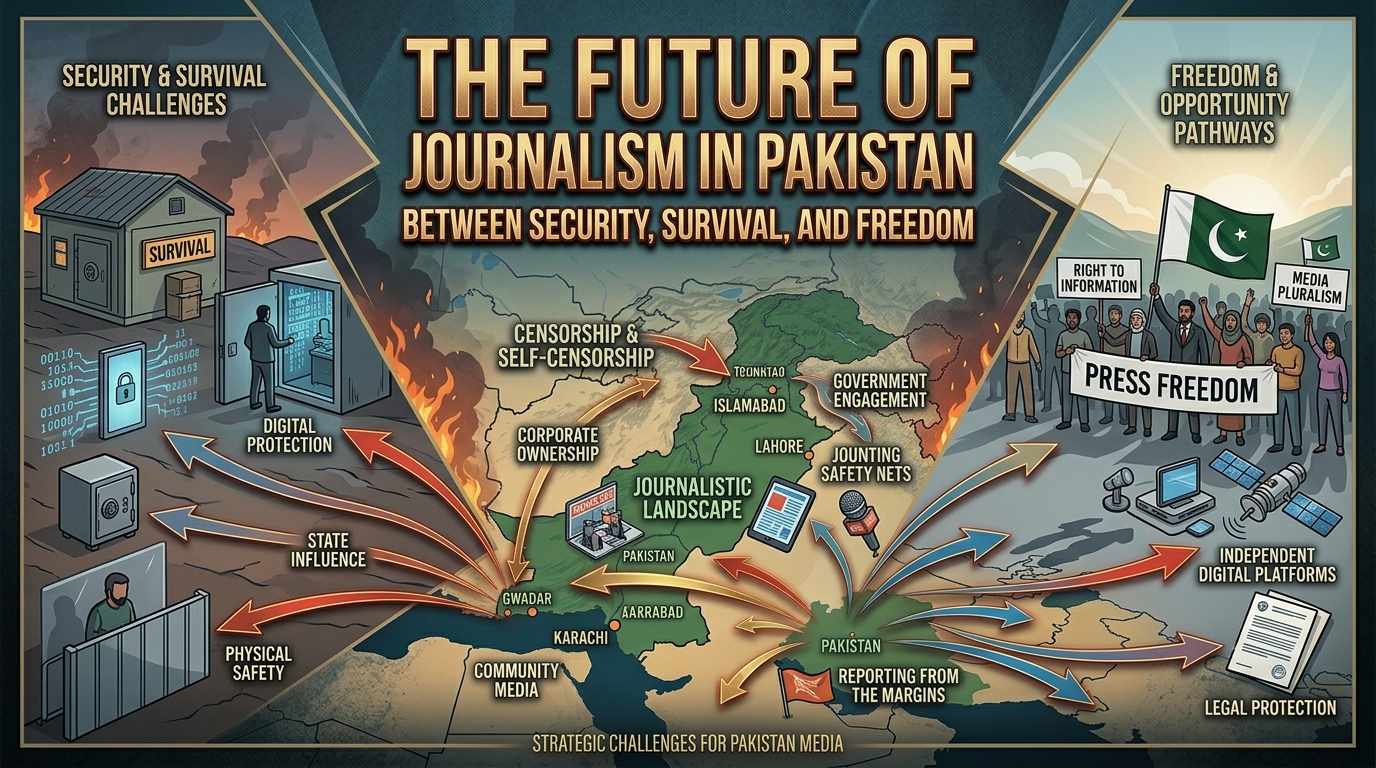
12 Jun The Future of Journalism in Pakistan: Between Security, Survival, and Freedom
Free media is often regarded as one of the defining characteristics of a democratic society. Democracy, in principle, thrives on freedom of expression, open debate, and the public’s right to know. Pakistan formally operates under a democratic framework, yet the realities confronting journalists raise fundamental questions about the nature and quality of that democracy.
The arrest of journalists, enforced disappearances, detentions by the Federal Investigation Agency (FIA), and prosecutions under cybercrime laws have become increasingly common. Alongside these pressures, journalists are losing jobs, media organizations are downsizing, and newsrooms are shrinking. These developments are not isolated incidents; they are interconnected symptoms of a broader challenge facing freedom of expression in Pakistan.
If democracy were functioning in its fullest sense, journalism would naturally enjoy greater freedom. However, the issue is not hidden, nor is it a new observation. The state itself often describes Pakistan as a security state. Such a model of governance requires a political structure, but that structure does not necessarily reflect the aspirations of the entire population. Instead, it serves to sustain an established order. Whether one describes this arrangement as a hybrid system or by another term, Pakistan has gradually evolved into a unique political configuration that differs from conventional democratic models.
This new political arrangement has also generated new legal and institutional requirements. Traditionally, the media was described as the fourth pillar of the state, responsible for accountability and public oversight. Today, however, the media is increasingly judged by a different standard: the extent to which it contributes to the state’s conception of stability. Criticism has never been particularly welcome in Pakistan’s political culture, and governments of all kinds have struggled to tolerate dissent. As a result, the media has historically operated under pressure. Yet the pace and intensity of these pressures appear to be accelerating.
A comparison with neighboring India offers useful insights. India’s global ranking on press freedom is far from exemplary, and concerns about media independence have grown significantly there as well. The rise of a hyper-nationalist political order associated with Hindutva ideology has transformed the relationship between the state and the media. Independent voices have faced increasing pressure, while political actors have simultaneously invested in creating their own media ecosystems. Internet shutdowns, restrictions, and campaigns against critical journalism have become part of this landscape.
However, India has also adopted another strategy: rather than silencing every dissenting voice, dominant political actors often seek to overwhelm alternative narratives through amplification of their own message. By speaking louder and occupying more public space, they reduce the visibility of competing perspectives. Yet despite these challenges, India retains a relatively vibrant community of journalists and civil society actors willing to challenge the state, question the ruling party, and scrutinize structures of power. Independent voices continue to exist and remain active.
Pakistan faces a different problem. Here, the journalistic class that historically participated in civil society activism and fought for media freedom has weakened considerably. Voices that once challenged authority are becoming fewer and quieter. In India, dissent is often drowned out by noise and competing narratives. In Pakistan, it is increasingly constrained through legal mechanisms. Laws such as the Prevention of Electronic Crimes Act (PECA), cybercrime regulations, and related legislation have become central tools in regulating public discourse. This distinction highlights a significant difference between the two countries.
Another recurring debate concerns foreign influence on journalism. Journalists frequently receive international training through programs such as the Chevening and Fulbright scholarships. Critics argue that such opportunities expose journalists to foreign influences, while supporters view them as valuable sources of professional development, capacity building, and exposure to international standards of journalism. The reality likely lies somewhere between these competing interpretations.
Despite these debates, Pakistani journalism has historically demonstrated resilience. It survived periods of censorship, political upheaval, and authoritarian rule. Today, however, its survival faces new and unprecedented challenges. More significant than foreign influence are the internal transformations occurring within Pakistan’s media industry itself.
Media organizations are struggling financially. Print journalism is in decline worldwide, and Pakistan is no exception. Reports suggest that even Roznama Jang, the country’s largest Urdu newspaper, is considering ending or significantly reducing its print operations in favor of digital platforms. English-language newspapers such as Dawn continue to fight for survival amid declining revenues and advertising restrictions. Downsizing, layoffs, internal conflicts, and financial uncertainty have reshaped the media landscape. These pressures are fundamentally altering the structure and functioning of journalism in Pakistan.
Governments have attempted to suppress journalism at various times, while media owners have often chosen accommodation and compromise. Yet media proprietors have largely failed to develop sustainable business models capable of supporting independent journalism during a period of profound global technological transition. While efforts have been made, they remain insufficient and fragmented.
Importantly, these challenges are not unique to Pakistan. International media organizations are also confronting debates about professionalism, objectivity, and partisanship. In the United States, for example, journalists and media outlets are frequently accused of political bias. Prominent commentators openly criticize political leaders, including former President Donald Trump, arguing that such criticism is part of their professional responsibility. Others contend that this blurs the line between journalism and activism. Trump himself has repeatedly described major outlets such as CNN and The New York Times as “fake media,” reflecting the increasingly polarized relationship between politics and journalism.
At the same time, another model of journalism continues to exist. Institutions such as the BBC traditionally emphasize impartiality, discouraging journalists from expressing personal opinions and encouraging them to focus on verified information and straightforward questioning. This model seeks to separate reporting from commentary and presents journalism as a public service grounded in objectivity.
Pakistan’s media environment is experiencing its own version of these tensions. Increasingly, journalists are perceived as aligned with political parties, institutions, or ideological camps. While such associations have always existed to some degree, alternative media platforms have made these affiliations more visible than ever before. Public perceptions frequently link journalists with specific political parties, whether the Pakistan Muslim League (N), the Pakistan Peoples Party, or other political actors.
These affiliations often extend beyond public commentary. Changes in government can bring opportunities for politically connected media figures, including appointments, contracts, official positions, and other benefits. This phenomenon has created a parallel form of journalism that is closely intertwined with political patronage.
Yet the greatest challenge remains the condition of the working journalist. Newsrooms are shrinking. Resources for investigative reporting are declining. Opportunities to gather, verify, and report original news are becoming increasingly limited. At the same time, alternative and digital media platforms have created new opportunities for journalists to reach audiences directly.
This dual reality presents journalists with two interconnected challenges: preserving their independence within existing political and institutional structures while also defending their freedom in an increasingly regulated digital environment.
The relationship between freedom of expression and cybercrime legislation illustrates this dilemma clearly. Many cyber laws were introduced with the stated objective of protecting citizens and safeguarding freedom of expression. In practice, however, they have frequently been used to restrict it. Journalists have been detained for criticizing judges. In smaller cities, local reporters have reportedly faced legal action for criticizing police officials. Instead of serving as protective mechanisms, these laws have often become instruments of control.
One must therefore ask whether the state ever intended these laws to function according to their original democratic purpose. Even with their flaws, fair implementation could still provide space for journalists, social media users, and civil society activists to exercise their rights. Yet widespread misuse has significantly narrowed that space.
Perhaps the state is uncomfortable with such openness. Perhaps media organizations themselves are reluctant to defend it. Perhaps citizens often do not fully understand their rights or the legal boundaries that govern online expression. Regardless of the reason, a serious gap exists between legislation and public awareness.
Laws continue to be enacted, yet there is little effort to educate citizens about them. Legal literacy remains absent from television, newspapers, social media, and even community-level discussions. Ironically, the government possesses the technological capacity to send nationwide alerts to every citizen when necessary. If legislation is important enough to regulate public behavior, why are similar efforts not made to inform people about their rights, responsibilities, and legal protections?
This question deserves far more attention than it currently receives. The future of journalism in Pakistan cannot be understood solely through the lens of censorship or political pressure. It must also be examined through the broader dynamics of changing state structures, economic decline in media, technological disruption, legal regulation, and the evolving relationship between journalism and power.
The future of journalism in Pakistan will ultimately depend on whether meaningful space can be preserved for independent reporting, critical inquiry, and informed public debate. Without that space, journalism may continue to survive as an industry, but it will struggle to fulfill its democratic purpose.
(This article is based on a discussion in Narratives with Amir Rana, examining the future of journalism in Pakistan and the challenges confronting media freedom in an era of political, technological, and institutional change. The podcast can be acceded at https://youtu.be/x8KyTr0K_Gg )