
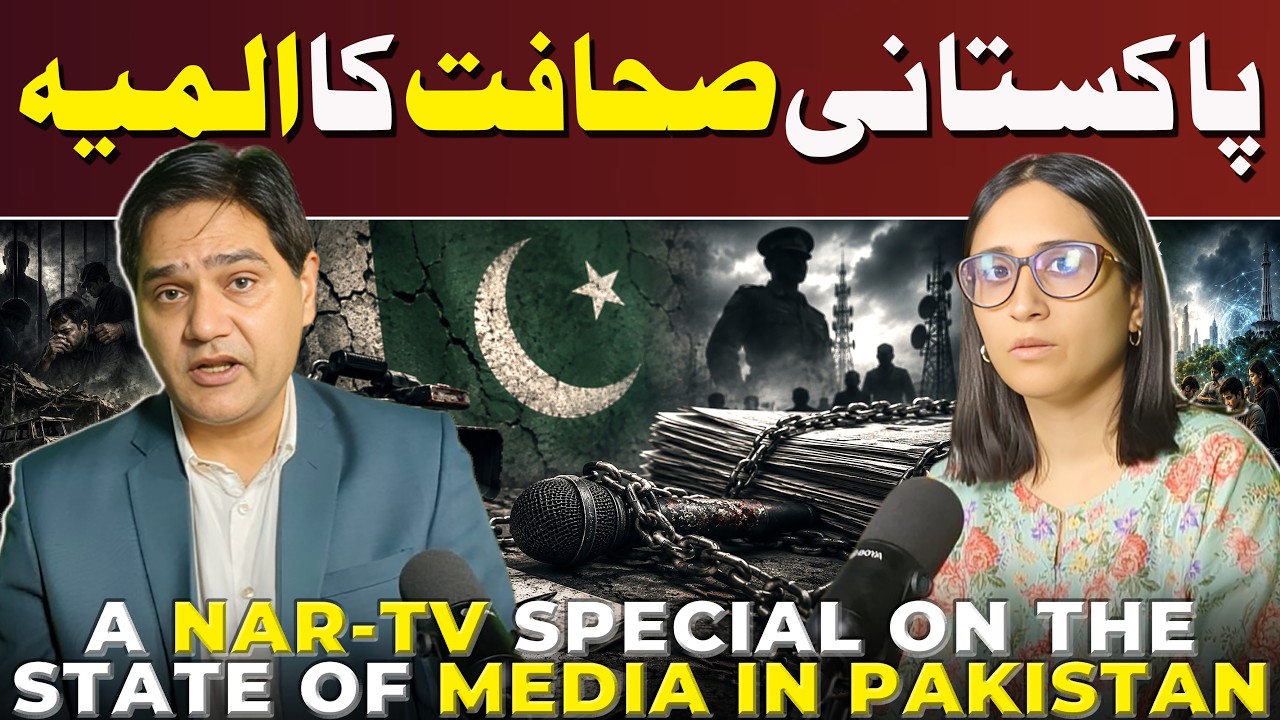
21 May What is the future of journalism in Pakistan? A conversation between Amir Rana and Areeba Pasha.
Hello and Al-Salamu Alaikum,
My name is Areeba Waseem, and today we are here with Narratives with Amir Rana. In this series, we will have conversations with analysts and various experts who will inform us about social issues, and today our discussion will be with Mr. Amir Rana.
Amir Rana: Ariba, first of all, welcome to the team. Narratives with Amir Rana has been around for almost a year now, so this is the first time that we have found a host to conduct conversations. In this, we will discuss various issues.
We will try to have in-depth discussions regarding social issues because in Pakistan, and particularly in Pakistan’s mainstream media, this is a major problem. Then even in alternative media, meaning YouTube and all these podcasts, the problem is that our focus suddenly shifts to one particular subject or issue, and then immediately another topic grabs our attention and takes us away. As a result, we are unable to have a complete and in-depth discussion on any subject. So Ariba, our objective is exactly this: to pick one theme and discuss it in depth.
The first program or series we are going to do is about media houses in Pakistan — how they are transforming. Then obviously, as soon as the word media comes up, democratic expression also comes to mind. Then laws like PECA also come to mind. Cases have also been filed against many journalists. So what exactly is happening inside media houses? Is journalism changing? Is the entire journalistic institution changing? Is this change happening in a positive direction, or is it a sign of decline and deterioration? So this is our plan for next week.
Question: Very good. Today, the discussion we will have is whether a free society requires a free media and whether it reflects democracy. We have seen that there is democracy in Pakistan, and through democracy, free media also receives protection, but there are many challenges. So what are these challenges, and what reforms can we expect from Pakistan in the coming days or years? What reforms can we expect that would allow free media to remain free and a free society to remain free?
Answer: First of all, I was very happy to learn that there is democracy in Pakistan and that we are a free society. Believe me, I was so happy that I could hardly contain my joy, especially since you are talking about freedom of expression in Pakistan’s media. Nowadays, as you can see, some journalists are being arrested, suddenly picked up, taken away by the FIA, and detained in cases related to the National Cyber Crime Agency. Then another thing happening is that journalists are being fired from their jobs. Media houses are shrinking in size. So all these things are happening, and they are connected with our freedom.
If there were democracy, then obviously journalism would also be free, because right now we cannot really call this democracy in those terms. This is not some hidden matter or something new that we are saying. Because the state and the people responsible for the state themselves call Pakistan a security state. And in a security state, to run governance, you also need a political setup. And this political setup does not necessarily represent the wishes of the entire public. Rather, it is a political setup that helps establish the order of the establishment. So whether you call it a hybrid system or something else, this is an entirely new political arrangement.
In Pakistan, this is a new political arrangement, and therefore it requires new laws. Media, which we used to call the fourth pillar of the state, now the fourth pillar also has to be evaluated according to how much role it is playing in accordance with the state’s idea of stability. Besides, we do not like criticism anyway, and how will governments and rulers tolerate it? So media has always remained under pressure. In this environment, we are seeing that things are changing very rapidly. We will discuss these matters with some working journalists, practitioners, and people from alternative media as well — how they view these developments, how they understand them, whether they see democracy and freedom of the press here or not.
Question: Thank you very much. Now, if we talk about journalists, as you also mentioned, they are facing many challenges in Pakistan. So if we compare this situation with neighboring countries, what analysis can we make regarding the freedom of expression journalists have there that journalists in Pakistan do not? What kind of comparative study can there be between Pakistan and its neighboring countries?
Answer: This is a very good and important question. It will help us understand the issue because we have always compared ourselves with India — what is happening there. India’s ranking regarding press freedom is also not particularly good, and Pakistan’s situation is obviously quite serious. In India too, you can see that a political transition is taking place. There is a hyper-nationalist party in power there, which we call Hindutva, and there is an alliance of hardline groups. Their pressure has also affected the media. What they did was, firstly, they created their own media, and secondly, they suppressed the voices of independent media. Then there are internet shutdowns and similar things that also happen there.
Thirdly, what they do is amplify their own voice. Sometimes instead of silencing another voice, you simply start speaking louder than them. You amplify yourself. You start shouting louder, and then no one hears the other person’s voice. This is what is happening in India. So India is not some exceptional case. But there is one difference between Pakistan and India: in Pakistan, that major journalistic class which used to engage in civil society activism and struggle for its freedom has become very weak. In India, that still exists, and they continue practicing journalism, standing firm, challenging the BJP, challenging the state. Wherever they see structures of power, you will definitely hear voices there. So there is still space in India.
The problem in Pakistan is that these voices are gradually falling silent. They are becoming fewer. In India, attempts are made to drown dissenting voices in loud noise, protests, and criticism, whereas here they do it through laws. There are laws like PECA, cyber acts, and many similar laws. So this is the difference between us and India.
Question: Can we say that Pakistan’s media is influenced by foreign powers? If yes, then how much impact do these influences have on our media policies?
Answer: This is also a good question. But first, what exactly are foreign influences? Some journalists go abroad. Whether it is Chevening or Fulbright, they earn degrees there and come back. Now you can call that capacity building or professional training — that is a separate matter. If you say they are bringing influence back with them, then that would be another kind of argument.
And as for Pakistan’s system, which you referred to as a democratic system, if it is democratic, then naturally its inspirations should come from democratic countries. But things are not really that way. The pragmatic framework of freedom of expression in Pakistan is very different. We certainly have very good relations with Saudi Arabia and the Gulf states — defense and economic relations — and many Pakistanis live there. But their system also influences the state, and it influences ordinary people as well. Then we have relations with China, which also influence us in one way or another.
Despite all these factors, journalism in Pakistan continued to function and survive. But now its survival has become difficult. More than foreign influences, I think another aspect is the changing dynamics within Pakistan’s media itself: the pressure on media houses, the decline of print newspapers. Since you mentioned neighboring countries, let me tell you that in Bangladesh and India, English newspapers, Hindi newspapers, and regional-language newspapers are still printed in large numbers, and their circulation is still in the hundreds of thousands. In Pakistan, the circulation of even major newspapers has fallen to just a few thousand.
Right now, the largest Urdu newspaper, Roznama Jang, is also rumored to be shutting down its print edition and moving online. In fact, the owners reportedly even want to outsource it entirely. Then English newspapers like Dawn are fighting for survival. Their advertisements have been stopped. So these internal issues are also putting pressure on media groups. Then there is downsizing. People are being fired, and there are job-related problems and internal conflicts. The dynamics have become extremely mixed.
The government has tried to suppress journalism. Media owners have always compromised. But they never brought forward a viable model that could sustain the institution of journalism and help it adapt to the ongoing global transition. So this aspect is not entirely absent in Pakistan, but it is definitely very weak.
Question: Thank you very much. Now my question is: are there any misconceptions about journalism in Pakistan or about Pakistan’s media policies? Are there misconceptions that exist both locally and internationally which we would like to clarify through this platform?
Answer: Yes, absolutely. Look, even in international media there are many issues. One issue is professionalism and objectivity — there are debates about this there as well as here in one form or another. This morning, I was watching Fareed Zakaria GPS on CNN in repeat mode. In one of his editorial segments, he very clearly criticized Trump, saying that for the past fifteen years he had been criticizing Trump and saying that he was not capable of handling these geopolitical matters.
Now this criticism of Trump — would you call it a professional norm, or would you say he has become partisan? President Trump himself calls CNN and The New York Times fake media. So what exactly are these dynamics?
Then there is another kind of journalism, which also exists in America, and the BBC is an example of it. There, the principle is that you should not comment, you should not give your opinion, and you should simply present information and ask straightforward questions. Like the way you ask questions right now — it feels like you are a BBC presenter. Straightforward questions, where it does not appear anywhere what your own view is. This type of journalism is considered professional journalism. But both these forms of journalism exist.
In the example I gave of Fareed Zakaria, he was doing an editorial segment in his program. Editorial means that you can express your opinion there. But where you are questioning and reporting news, there you cannot exercise that freedom in the same way. So these are different forms. And obviously every journalist has a point of view. But it should not appear in their reporting. It may appear in their editorial insight.
This is where things have become confused in Pakistan. Here, issues are no longer discussed objectively. Journalists have become aligned with political parties. They have become associated with different institutions. They were associated before as well, and now an even larger chunk is becoming aligned because alternative media is emerging. It is now very obvious which journalist supports the Pakistan مسلم League (N), which one supports the PPP, and where their interests lie.
And these interests are also reflected when governments change. Their governments may not even have come into power yet, but their beneficiaries are already prepared. They receive positions, government offices, contracts, even houses. So this is a different kind of journalism.
The real challenge is for the practitioner journalist. Newsrooms are shrinking, and there is less space for reporters to report and uncover news. There are many different trends at play. And right now, I think this alternative media — which we ourselves are using at the moment — has a lot of potential. But only if it is used effectively. At present, we have become prisoners of algorithms. We are trapped in their captivity. We just keep doing whatever the algorithm tells us to do. At some point, we will have to bring our own expression and freedom into this space.
When we talk about freedom of expression in the context of the state, democracy, and its framework, it is very important. But now, within this new corporate, AI-driven cyber and virtual space, there is also a need to exercise freedom. So now journalists face two kinds of challenges: one within their own regime, and another within cyberspace — how to maintain their freedom in both places.
Question: Time is short, but we will ask one final question, and it is related to cybercrime. Do cybercrime laws in Pakistan limit freedom of expression? Do they curtail freedom of speech, or do they protect freedom of speech?
Answer: Absolutely, these laws were originally made to protect your freedom. But as always, they also began to be misused. Then we saw that over a small news report or some incident, even a senior journalist recently was picked up in Sangjani, Islamabad. Sometimes a journalist is arrested for criticizing a judge. In smaller cities, journalists are even arrested for criticizing an SHO. Instead of protecting their freedom, these laws have mostly been misused.
Perhaps the state itself never intended for these laws to be exercised in the way they were originally designed. Despite all their flaws, if they were implemented properly, there would still be some space left for journalists, social media activists, and civil society activists to exercise their rights. But because of the misuse, that space has disappeared. And perhaps the state does not want it either. Media houses also do not want it. And in many cases, people themselves do not know which actions fall under violations because there is no awareness.
Laws are made, but there is no literacy about them — not on television, not on social media, not in newspapers, not even on WhatsApp. The government can send security alert messages to all citizens of Pakistan with a single click whenever it wants. So, if they are making such legislation, why do they not also take measures to spread awareness in the same way? This is a very serious matter.
And when we discuss this issue further, we will talk to experts like Asad Ali Toor, Zarrar Khuhro, Arif Noor, Muneezeh Jahangir, Bilal Ghauri, Umar Cheema, Azaz Syed, and others as well. As we said earlier, we want to bring this entire debate openly before the people so that it becomes clear what the real issue is. Where is the journalist at fault? Where are media owners trapped by their interests and making compromises? Where is the state making mistakes? And most importantly, whether together we can create a better situation or not.
Areeba Waseem: Thank you very much. And this was our session with Narratives with Amir Rana.
Amir Rana: Thank you very much for watching. Next time, we will return with a new topic. Until then, goodbye.